

Throughout my career as an ESL teacher, I have always believed that games are one of the best ways of teaching English to young kids! Language games add the important element of fun to learning. This is crucial in developing a positive association with a new language; one which will hopefully stay with a child for life!
Games encourage many different skills; speaking and listening, problem-solving, as well as motor skills. Playing games together is also a great time for connecting with children.
Here are four different categories of games that I believe work really well for teaching languages to kids!
1. Flashcard games
Flashcards can be so much more than passive, one-way teaching aids – they’re a great resource that you can use to play countless fun games with young kids!
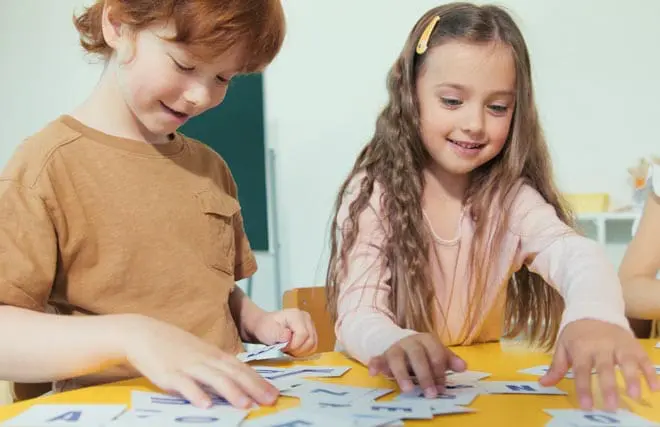
Why flashcards games are great:
- They’re versatile: Many games with flashcards can be adapted for playing in large classrooms, one to one classes, or any size group in between, making them a great tool for any teaching environment. Many simple but fun games such as Kim’s game, Pass the Parcel, Simon Says and Chinese Whispers (Telephone) can all be adapted for playing with flashcards.
- They’re portable: Flashcards are easy to carry around, which is especially useful if you don’t have your own fixed classroom or a lot of space to store materials, or you just want a simple activity to play with your child when you go out. Many teachers prefer to use real objects in their lessons instead, but if you have to move from class to class flashcards are a more practical alternative to carrying a huge bag of materials around with you!
Check out my article for five of the best flashcard games to play with young kids!
2. Board Games
Board games are great for teaching a second language in a fun and dynamic way, while also encouraging other key skills:
Social skills: Board games help teach young children important social skills such as sharing, team-work, patience, and taking turns.
Cognitive skills: Playing board games can help develop focus, concentration and memory skills. They are also a chance to reinforce number, letter, colour or shape recognition, as well as hand eye coordination and fine motor skills.

Suggestions:
Use board games designed for native speakers
- Many of the board games designed for preschoolers will work for teaching any second language, as they use pictures rather than words to play. However, there are also games that require children to match the first letter of a word which are perfect for children learning to read, and in this case you do need to buy the game in the language you are teaching.
Using board games in the classroom
- The biggest drawback to using board games in the classroom is obviously the fact that most games are designed for 2 – 4 players. With groups of 6 – 8 kids I usually pair the children up to play, which works well. In larger classes you can form smaller groups and give each a game to play, rotating the groups if the games are different. It is important, however, to bear in mind the playability and playing time of the game.
Playability
- Board games with simple rules and colourful pieces are perfect for pre-school to kindergarten age kids. For language teaching, games that focus on specific areas of vocabulary, such as food or farm animals, are ideal.
Playing Time
- Pre-school age children are old enough to sit down to play but they are still quite wiggly, so games with shorter playing times work better; 15 to 20 minutes is good.
Take a look at my printable games here! All my games are available in English and Spanish, and many are editable so you can change them to another language.
3. Song and Action Games
Songs and games that encourage action and movement are great, not only because they get kids moving around, but also because they help them clearly associate words with their meanings.
There is a methodology based on the coordination of language and physical movement called TPR, which we’ll briefly outline here:

TPR (“Total Physical Response”)
TPR, or Total Physical Response is a language teaching method that is perfect for young children. TPR activities focus on learning though physical movement, and centre around instructions with action verbs and the vocabulary you want to teach. As young children are naturally quite restless, TPR activities are a great way to get them burning off some energy while they learn!
Action songs like “Head, shoulders, knees and toes“, “I’m a Little Teapot” and “Teddy Bear, Teddy Bear turn around“, and games such as “Simon Says” are excellent TPR activities that can be played even in a small classroom.
4. Role-play or Dramatic Play
Children learn by copying what they see in their environment. They naturally mimic the adults in their life, using games and play to represent roles, attitudes and scenarios that they see around them. This is called role play, or dramatic play.
It has been shown that this type of play builds skills in many key areas of a child’s development, including language skills, social and emotional skills, thinking skills and problem solving, and of course, imagination.
You can take advantage of this natural tendency to role play in order to teach a second language. By providing a structured framework and materials, you can encourage children to simulate jobs, roles and real life situations, while practicing key vocabulary and phrases.
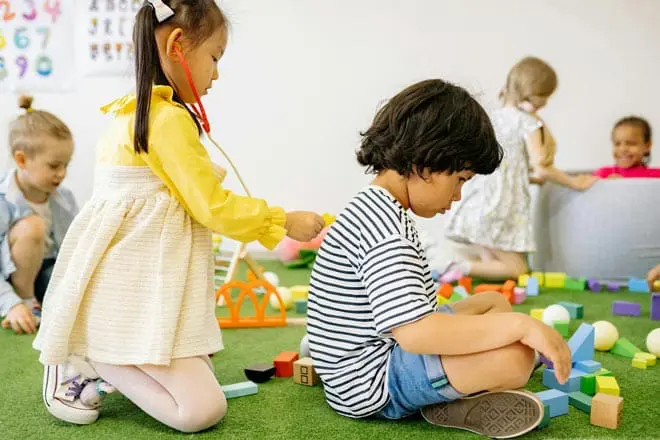
Of all the types of games I play in class, in my experience role playing games are the most popular! My kids absolutely love dramatic play time, and will choose it over all other kinds of games. I’ll be dedicating an entire article to setting up role play activities in your ESL classroom in the near future!
SUBSCRIBE to my free newsletter for discounts and updates on new resources!

Please read the FAQ for full info about how you can use my resources.


In my country we like to change the rules a little bit in Kempt you can choose an audible sign and you must choose a secret number let’s say 5 so if you are collecting 6 you could ask your partner if he have a card with a number higher-up than the secret number by one and if you think that the opponent team got a 4 cards with the same number you should say stop and in spoon we don’t actually use spoon but we choose a number like 3 or 2 and when you get the 4 cards you put your hand on the table and the other players must put their hand on your hand as fast as possible and the last one to touch your hand get a point the first one to reach the number of points that you decided will get out so to get rid of one it may take double or triple the time that it take in the normal game.
Victoria Tegg
Thanks for that! So many great games to play with kids. The ones you describe sound perfect for second grade and above!